The Campus Monopoly · Course 01
Be the first to build what your college actually needs.
In October 2024 I couldn’t find decent material for a maths midterm, so I learned enough coding to build UniCheatSheet overnight. It has since handled over 2 million requests. The Campus Monopoly is everything I learned building, growing and monetising it.
- 2M+Lifetime requests
- 500K+Requests per semester
- Oct 2024Built overnight
$29 international
What actually happened
The numbers behind the case study
This is UniCheatSheet's record, not a forecast for anyone else.
These describe one platform, at one university, built by one student. They are not a promise about what you would make. Nothing here is guaranteed income.
The origin
It started as a way to not fail a midterm
There's no impressive founding story here. That's sort of the point.
October 2024
A maths midterm coming up, and the material I needed scattered across a dozen places.
The obvious question
Why is there no single place to put the useful stuff — notes, PYQs, solved worksheets — so I and everyone else can just find it?
YouTube
I didn't really know how to build it. I learned enough to start, which took less time than you'd think.
Shipped overnight
One semester. A handful of subjects. No slider, none of the features it has now. It solved the problem I actually had.
About a semester later
Two students across the table were using my website. They had no idea I was sitting opposite them.
I was in the university library. They had UniCheatSheet open and were arguing about one of the solutions on it. Not because someone told them to use it. It had just travelled far enough that it had stopped being my thing and started being a thing people used.
That is what word-of-mouth actually looks like on a campus — and it is the closest thing to proof I’ve had that the product was doing its job.
The idea
Most students look outside college for something to build
Meanwhile the campus you're already on has recurring problems, a concentrated audience and distribution built in.
What you'll learn
This is about decisions, not syntax
No advanced coding knowledge is needed to follow the course.
Curriculum
Eight lessons, in the order I learned them
Expand any lesson to see what it covers.
01 — The First-Mover Advantage
Why being first on campus compounds — and what it actually bought me.
Freedom to experiment before anyone was watching
Time to fix the product while expectations were low
Campus recognition and accumulated trust
A resource network that got easier to grow over time
The library moment — and what it told me about word-of-mouth
02 — How to Make a Bad Website
Three competing platforms appeared later. Here's what I watched go wrong.
Too many clicks between a student and the thing they came for
Login and interaction friction at exactly the wrong moment
Confusing navigation when the user is already stressed
Promising content, then showing “coming soon”
Complexity that serves the builder, not the student
03 — How to Make a Good Website
UniCheatSheet as the worked example.
Cut clicks — every one loses people
Navigation a stressed student can use without thinking
The Netflix-style slider, and why it beat a list
Multiple contextual CTAs instead of one buried button
A consistent design language, and borrowing patterns from interfaces that already work
04 — Using Your Unfair Advantages
Don't try to be me. Work out what you already have.
Socially connected → you can get the resources
Academically strong → you can make better solutions
Technical → you can build and customise it yourself
Design or marketing minded → you can handle distribution
Non-technical → a template or the planned Starter Kit is a valid starting point
05 — The Workflow
How a student actually moves from discovery to access.
Discovery → navigation → resource → paid content
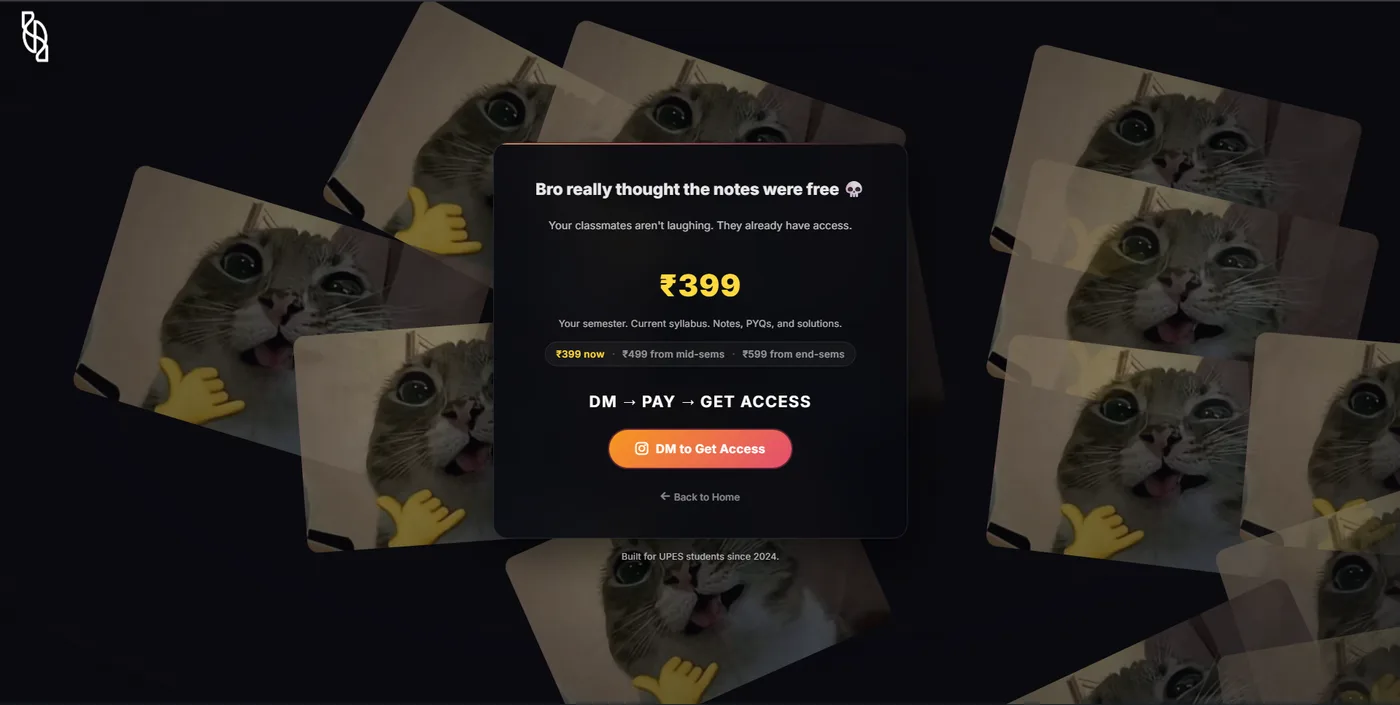
DM → payment → access
Where students drop off, and why
Keeping the path short enough to survive exam week
06 — The Third-Party Payment Automation Problem
Why I started with direct UPI and manual fulfilment — and when that stops being right.
Immediate visibility over every transaction
Simple operations you can run between classes
A direct relationship with early customers
No infrastructure you don't need yet
Infrastructure should follow scale — this course itself uses a payment gateway, because the situation is different
07 — Instagram Automation
Removing yourself from repetitive purchase conversations.
Keyword-triggered replies
Automating the FAQ you answer twenty times a week
Automated payment and access instructions
What still has to stay manual, and why that's fine
08 — The Pricing Problem
Free → ₹199 → ₹299 → ₹399, and the mistake I made at the start.
Why I kept it free for four semesters — and why that was too long
What changed when students started paying
Raising the price without losing the room
Why sustainable economics matter when you're the one maintaining it
Pricing depends on your campus — mine is a data point, not a formula
Recording is still in progress, so total runtime isn’t listed yet — I’d rather leave it blank than make a number up. Buyers get every lesson as it lands, plus anything I add later.
Real artifacts
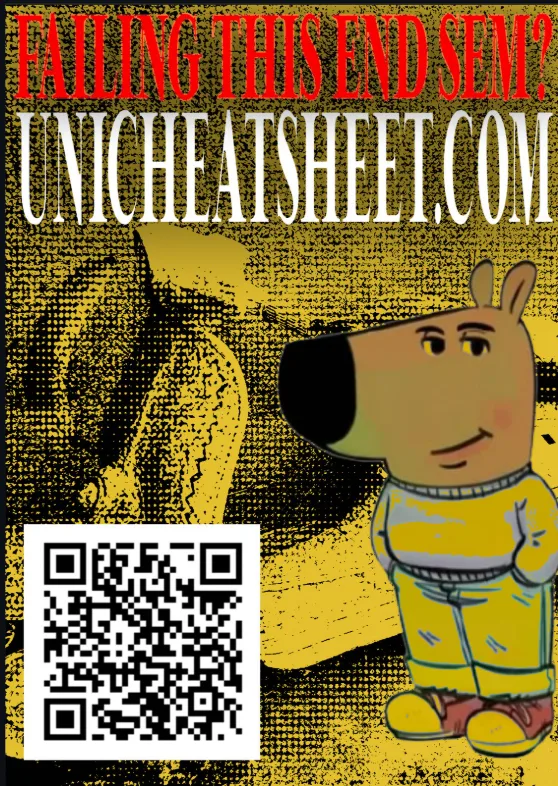
What the marketing actually looked like
Two things from the real platform. Neither was made to impress anyone.
Monetisation
Free for too long, then four price changes
How the money model actually evolved, including the part I got wrong.
I switched from local-business promotion to student subscriptions for one reason: someone who came to study shouldn’t be reading a café advert to get to their notes. Monetisation should hold the product up, not get in front of it.
What I watched happen
Three competing platforms turned up later
In the course I break down what I think each of them got wrong. Here is the short version.
Too much friction
Logins, extra clicks and clever features standing between a stressed student and the one file they came for.
Promises they didn’t keep
Content advertised across a long list of courses, then a “coming soon” screen when you opened one.
Not enough worth coming back for
A platform is only as good as what is actually on it. Thin resources get found out in one exam week.
Economics that didn’t last
Free, or priced too low to cover the work. Maintaining something useful takes continuing effort, and that has to be paid for somehow.
These are my observations as a competitor, not objective judgements about anyone else’s work — building any of this is hard. The pattern I take from all three: low friction, promises you keep, resources worth returning to, and economics that survive past one semester.
Fit
Who this is and isn't for
This is for you if
Skip it if
The offer
One payment. Everything, including what comes next.
Two prices set independently for the two regions — not a live currency conversion. Pick the one that matches where you’re paying from.
The Campus Monopoly
The Campus Monopoly — Starter Kit
The course teaches the thinking. The Starter Kit gives you an implementation head start. It’s a cleaned, university-agnostic version of the UniCheatSheet codebase with my personal content stripped out — commented customisation points, setup and deployment guidance, and a short technical walkthrough.
Entirely optional. The course stands on its own, and nothing in it depends on the Kit. If you can build, build.
when it’s ready
Questions
Before you buy
Do I need to know how to code?
Not to understand the course. It's about product decisions, distribution, resources, pricing and friction — not syntax. To actually build something you'll need either some technical ability, a website tool, or the Starter Kit that's planned as a separate product.
Will I make money from this?
There is no guaranteed income here, and I won't pretend otherwise. I'm showing you what I built, what happened, and what I'd do differently. What you get out of it depends on your campus, your execution and a lot of things neither of us controls.
Is this only useful for engineering students?
No. The framework applies wherever there's a recurring academic-resource problem and a concentrated student community. What you build, and how hard it is, depends on your institution.
How long do I have access?
Lifetime access to this course, as defined in the Terms & Conditions. You pay once — there is no recurring charge and nothing to cancel.
Do future lessons cost extra?
No. If I add lessons to The Campus Monopoly later — based on what I keep learning running UniCheatSheet — existing buyers get them at no extra cost. I am not promising a release schedule or a set number of future lessons, only that you will not be charged twice for this course.
Is the Starter Kit included?
No. The Starter Kit is a separate optional product and isn't available yet. The course does not require it — a technically capable student can watch this and build their own.
What language is the course in?
English. There are no subtitles or other language versions at the moment.
Can I share or resell the course?
No. Access is personal and non-transferable, and the content can't be redistributed or resold. The full terms cover this.
What if it isn't for me?
There's a 7-day refund window from purchase and you don't need to give a reason. The full refund policy is linked in the footer.
Anything else, email me: contact page.
The whole idea
Every college has a problem everyone complains about. Almost nobody is first to fix one.
I was, once, by accident. This is what I learned.